
Thursday 6th May
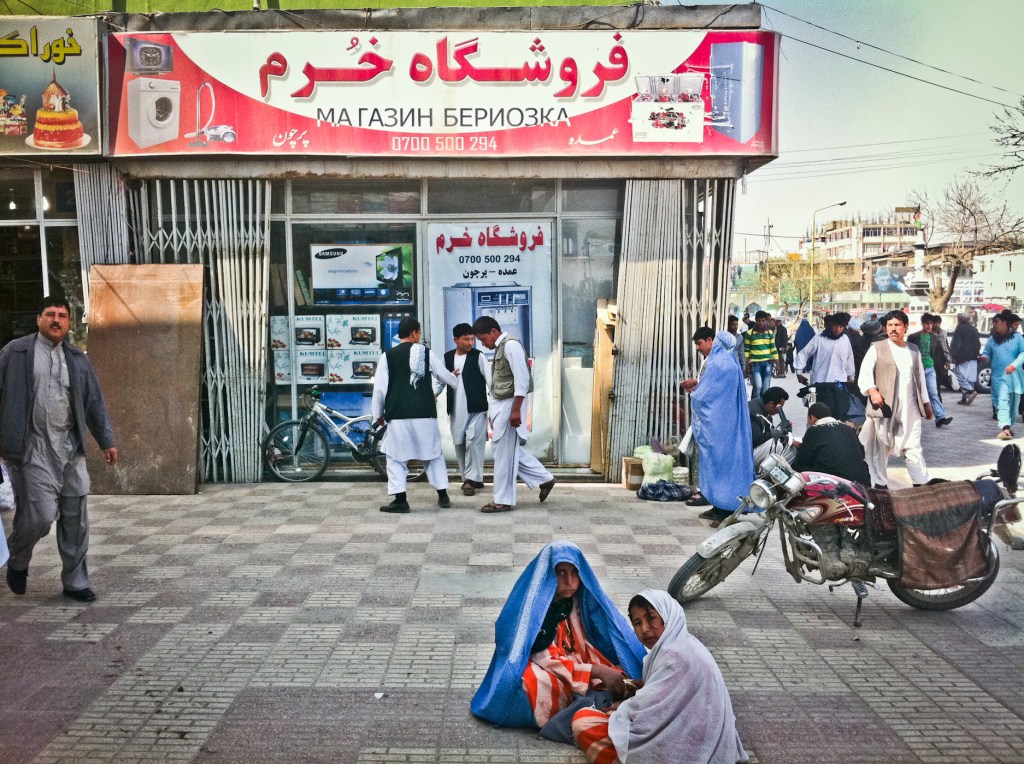
As it looked like being a very hot day, we rose early and went down to the bus meeting place and found a mini-bus going to Balkh. The town we visited we decided was not the ancient Balkh, although it had very fine fortifications. The place was teeming with activity – obviously we had come on a market day. We saw lots of camels, donkeys, horses – the people mostly seem to be very poor, but not unpleasant.

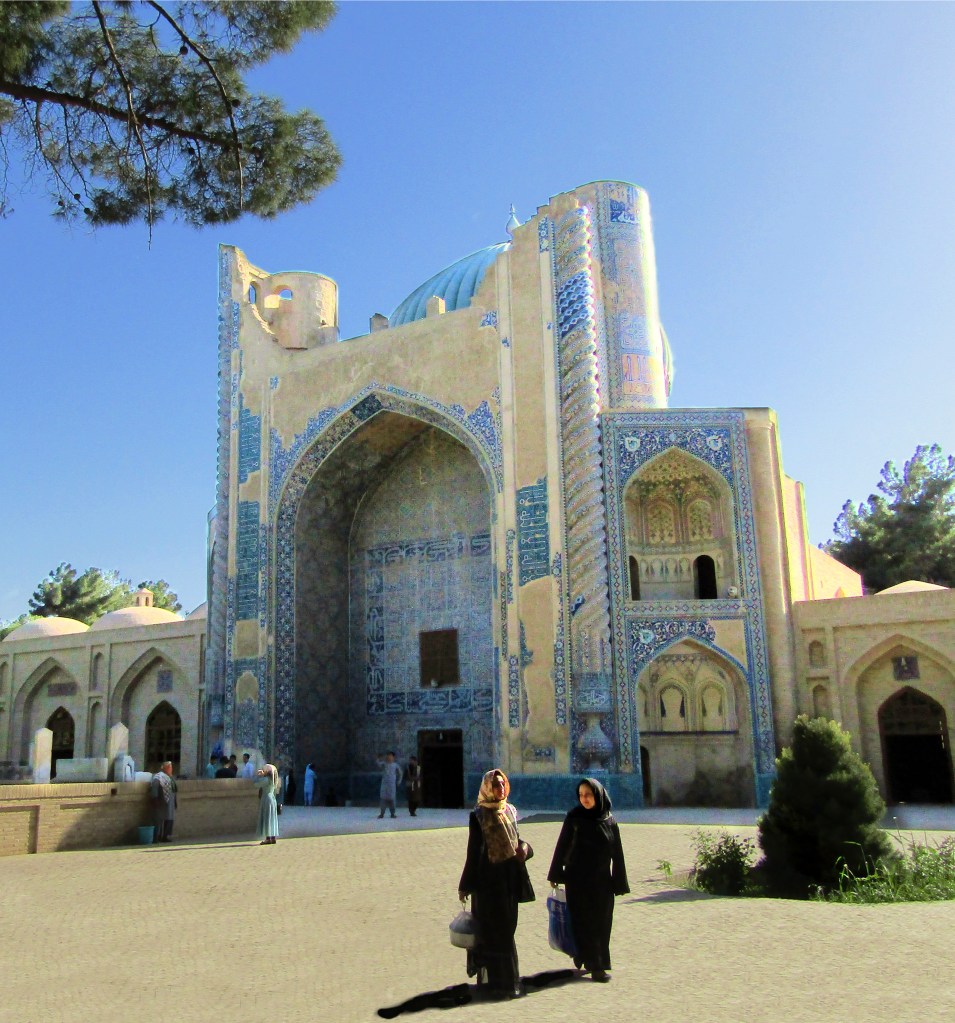
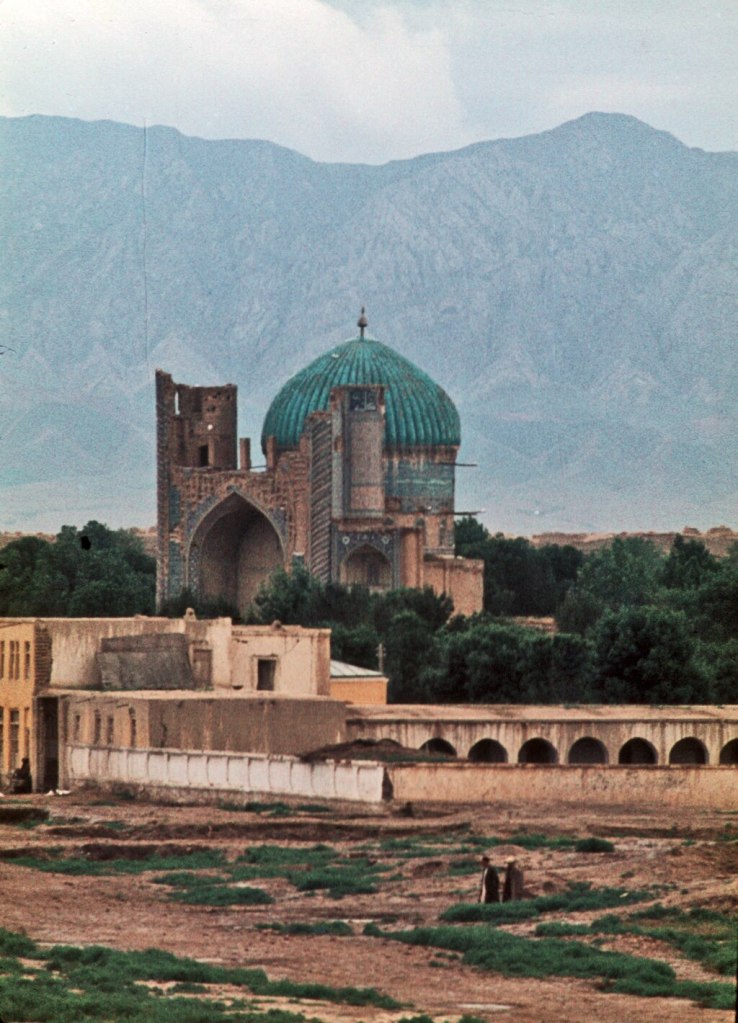
In the central square (a garden) there was an old half-ruined mosque [see below, photos from 2001], with the same old turquoise tiling. We had one of the renowned Mazar-e-Sharif ice creams on our return from Balkh and spent most of the rest of the day swooning from heat (and laziness) in the hotel – as Mazar isn’t particularly exciting we didn’t feel we were missing anything.
In the evening we returned to the restaurant of the night before and had a delicious pilau again. It was slightly sad to say goodbye to the others after spending so many days together and sharing so many experiences, but perhaps we shall meet again on the road somewhere.
Friday 7th May
We got knocked up at 4:30 in the morning and took one of the horse gigs down to the bus – the oldest one I’ve seen yet, with a long bonnet and absolutely crammed with people. Luckily had the front seats by the driver so no one squashed us.

At first the land was flat, save for an escarpment on our right. We passed several attractive mud villages, with many trees surrounding them. Then we plunged straight into a gorge taking us through the mountains – very narrow and obviously a place for landslides as we saw several fallen rocks. The wheat here was a very bright green interspersed with poppies and purple flowers.

Pul-e-Khumri we found bristling with people and quite a large town. There was a truck going to Bamiyan two hours, so we spent the time in a chaikhana, drinking tea and reading. At last we set off, with 20 men and a donkey, not to mention great big rocks of salt and sacks of sugar– terribly overloaded.

We seemed to be stopping all the time and making very little progress – stopping to let people on/off, to fill up the water tank with filthy water (which the people also drank) and stopping to get out and walk where floods had washed the road away.

The mountains were steep and rocky with great multicoloured seams. We passed several attractive villages, baby donkeys, foals, kids and lambs of course – even the ruins of an old castle high on a natural rock fortress – very striking in the evening light. At last we arrived at a village [Doab] where we were told we could go no further, as the driver didn’t have enough people to make the trip worthwhile. So we sat annoyed in a chaikhana and old man turned up. He spoke fairly good English, a great surprise in such a small place (he was the local agricultural advisor). He was very helpful, managed to procure us a room (a carpet on the floor) and helped us get some pilau and meat.

We were so tired after our early start that we went to bed just after nine. I almost forgot to mention my neighbours on the truck – an Afghani school teacher, his Pakistani wife and five month old baby – huge eyes but quite pretty, it peed all over my trousers which the father thought a great joke; his wife, a very beautiful young girl, lent me a needle and thread and I sewed up my purse.
Saturday 8th May
Woken by the sound of voices in the chaikhana below so we got up in order to see if any transport should arrive. We had hard-boiled eggs and bread and tea for breakfast and then our friend took us for a walk in the country. The town is called Doab (two waters) because of the confluence of two rivers, one whiteish from Bamiyan, and one red, full of minerals from the red hills. He showed us an old fortification on the top of the hill, two ziggurats (tombs of Saints to which people make pilgrimages and leave scarves tied to long poles). On one of them we saw some people cooking and were told that the food would be given to the poor, and corn and rice mills both operated by water. We returned to the village and soon after a lorry arrived bound for Bamiyan.

Had terrible difficulty climbing in the thing, but we were seated on sacks of rice and had quite a lot of legroom (to begin with anyway). My neighbour on this journey was a recaptured convict, who I gathered had escaped from Bamiyan jail and, after a scuffle with soldiers and some shooting, he was recaptured and was en route back to jail. He recounted his tail with obvious gusto to all, backed up by the police guard, and seemed to think it all extremely amusing as did some of the occupants of the truck. Others signed to me that he was a murderer and that I should be careful. He had huge shackles on his feet making it difficult but not at all impossible to escape – and the policeman didn’t guard him closely either – so it was no surprise to learn of his previous escape.
The lorry appeared to stop as much as the truck of the day before and at one point let on about seven peasant women and about seven children, from eight months up to 14 years, all dressed in beautiful dresses over flowery baggy trousers and headdresses of brilliant scarlet. Many of them wore wide silver bangles and earrings and nose rings. The babies had on embroidered caps with old coins dangling on the forehead.

But they were extremely aloof (except when it started to rain and we got under our blanket to be suddenly greeted by three Afghanis also seeking refuge, without so much as a by your leave!. It was terribly bumpy and uncomfortable as all the sacks disappeared. We eventually arrived freezing cold in Bamiyan after nearly 6 hours.

We found the Mustafa hotel straight away, whether there was a central samovar giving out heat from the fire. We had hot water baths (in basins) from a sort of hammam, one tap very hot, one tap warm – very refreshing. We are so tired that we went to bed at 6 pm and slept for 12 hours without venturing out into the town at all – it did pour with rain soon after we arrived and did not cease before we went to bed, so we did have an excuse.
Sunday 9th May
Bamiyan was a place of pilgrimage on the Silk Road linking the markets of China with the west, and also for us, because of the two Buddhas, dating from the 6th century AD. Although Bhuddist in origin, they survived successive Muslim regimes until 2001, when the Taliban had them destroyed, as worship of effigies is forbidden in I|slam.
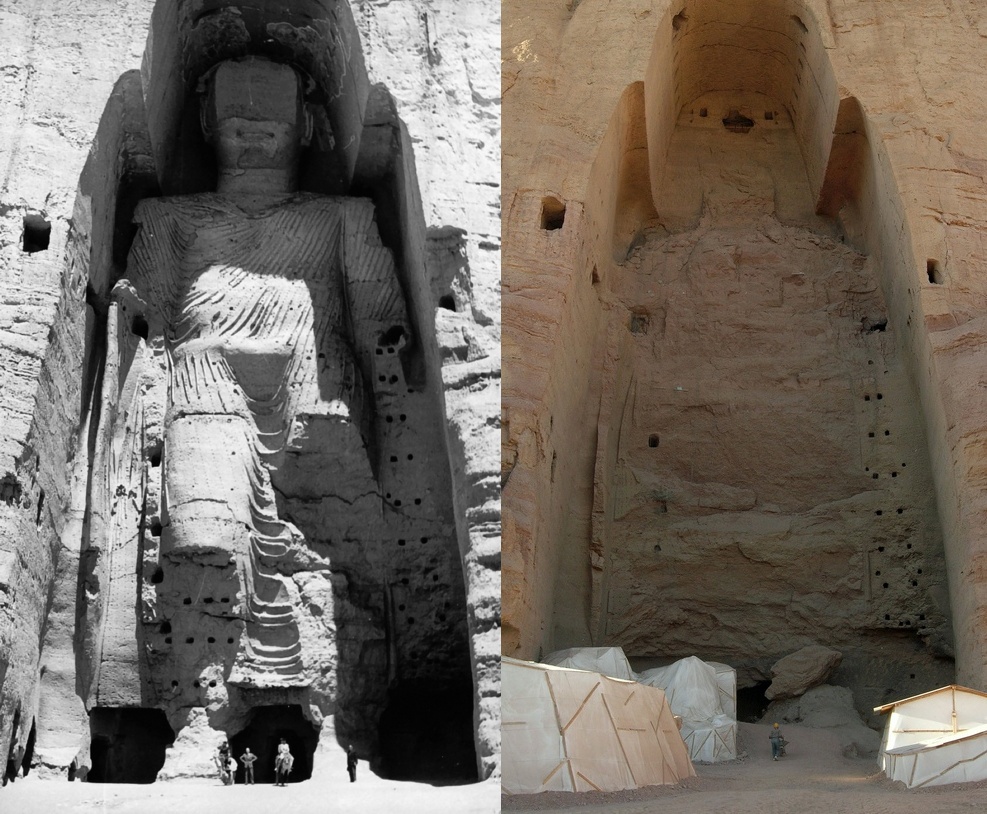

They are both carved out of the sandstone cliffs and were then plastered with mud and straw; they were then painted over, although this had all vanished by the time we saw them. There were also intricate murals above each Buddha.


We got up really early, a bright hot sunny morning, and set off to find the second smaller Buddha, which is in many ways nicer than the large one (which also has a large entrance fee). We found a massive jewellery shop selling old and new chokers and things; bought a couple and got a free ring, baksheesh.
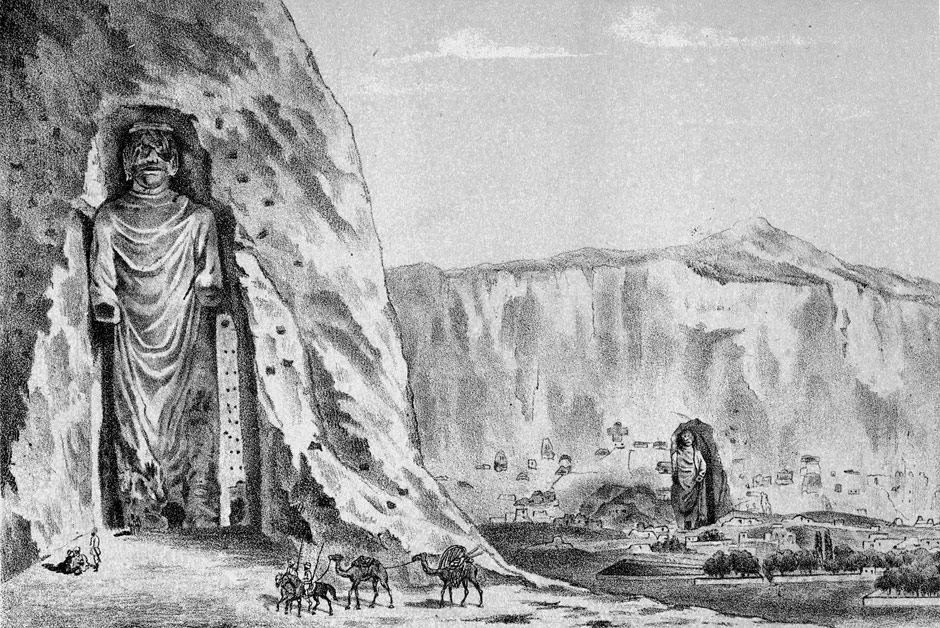

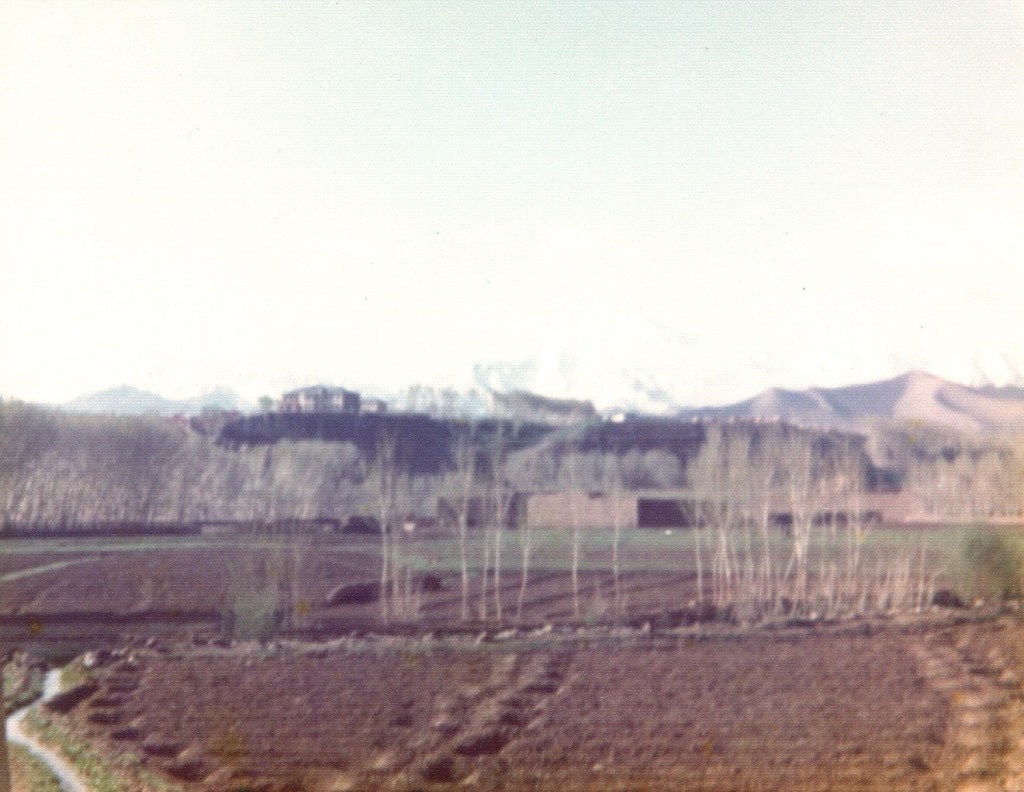
Bamiyan in the 1890s and the 1940s
Bamiyan is a lovely small town revolving around the main street – one-story buildings lots of cheap hotels. cake shops and bazaari shops. Up the other end of the village came across a group of Afghani horseman – very typical and picturesque. We then skirted round the back of the town and started to climb up to the top of the hill that encases the big Buddha, very windy and steep. When we got a fair distance up we discovered a tunnel which let us onto the Buddha’s head! Lovely view but an argument with the guard!

The best thing here is the early morning policemen‘s parade, which we witnessed twice. They march around the open space at the foot of the Buddha and obey commands whistled by the chief. The first three march very energetically, but by the end of the line it’s little more than a shuffle! In the afternoon it turned cloudy and cold so a short walk was about all we could manage. No transport to after 7 am so we spent two nights here.

 Vicky's Big Adventure