About the Kalash
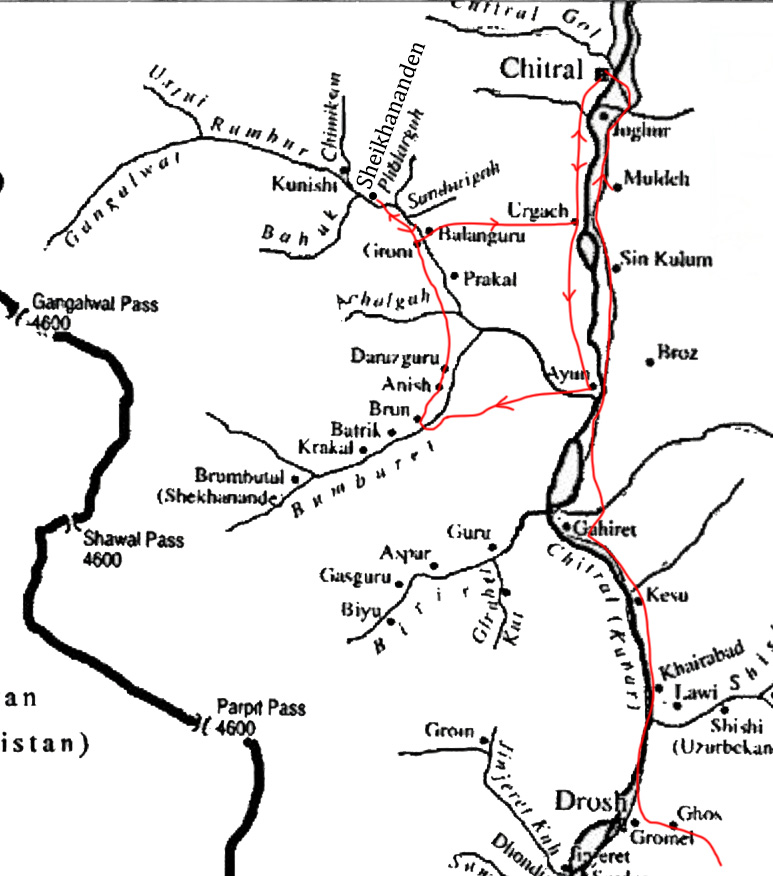
The Kalash, now numbering only a few thousand people, live in villages along three main valleys – Birir, Bumburet and Rumbur – and are a very ancient people, who believe in animism and ancestor-worship – hence the Muslims branded them the ‘Kalash Kafirs’ ,or unbelievers. They live in a small area of Nuristan bordering Afghanistan, as you can see on the map.
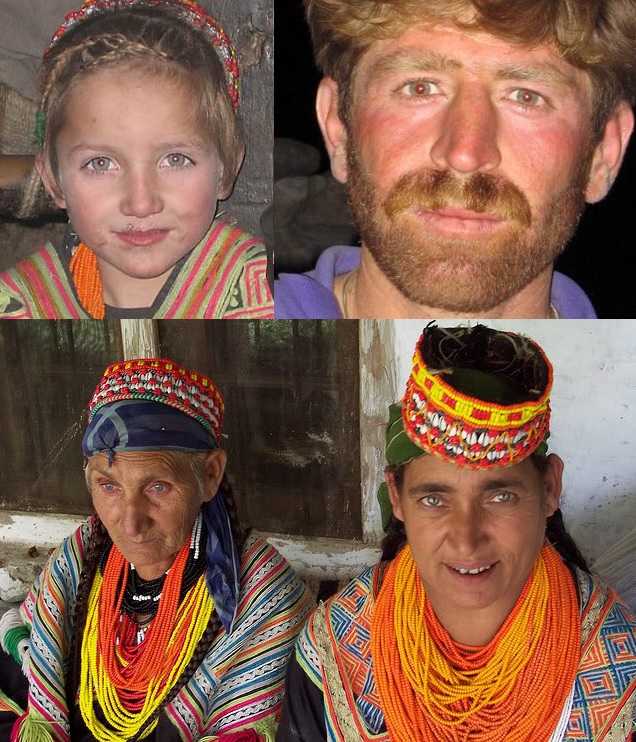
There have been numerous genetic analyses of the Kalash to determine their origins , among them the claim they are descended from Alexander the Great’s marauding armies, due to their fair hair and blue eyes. There is no scientific evidence for this but it is agreed that they are totally unique and there is some genetic footprint and cultural evidence from 24,000 year old Palaeolithic Siberian hunter-gatherer groups.
They have suffered greatly since the spread of Isalm and their lands have been restricted from five to three valleys, and they have been subjected to forced conversions and attacks, which limited their numbers to 2000 at one stage. More recently, the Pakistan government has protected them (the tourist dollar no doubt) and attacks by the Taliban on them and the Ismaili communities in Swat outraged locally Pakistanis so much that the protection increased. Prince William and Katherine visited them in 2019, accompanied I believe by one of our friends who was their private military escort! Small world!
When we travelled there in 1976 the valleys were only accessible on foot, and by climbing over the mountains as in the spring, when we visited, the bridges and paths get washed away. Recently due to global warming, floods in Kalash valleys have proved devastating with many houses washed away. Saifullah Jan, Peter’s fixer, now a big leader of the Kalash, has lobbied successfully for interventions to protect the communities.
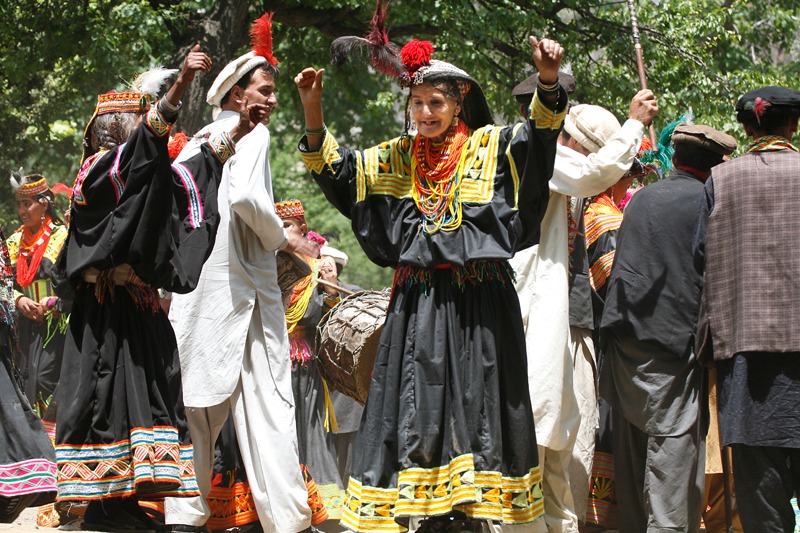
Now fancy tour companies such as Wild Frontiers can arrange trips to the Kalash valleys by jeep – but it has really changed, judging from the photos in the various brochures – gone are the cowrie headdresses, replaced with woven caps and new headdresses in garish colours, and gone are the black dresses that they (and I) wore.
It was a real privilege to visit when we did, arduous though it was! But then we were young…
Tuesday 18th May
J got up at 3 and proceeded to (try) to make tea in our water bottle – quite revolting as the milk all coagulated inside. I got up at about 4 and we woke the Austrian with difficulty. Just after 5 we were ready, but the Austrian had decided he was too weak to make it – and, feeling rather guilty as he said he would find a guide, he walked with us as far as Darasguru, the first village in Bumburet. There we met three men (Chitralis) who were going to Rumbur, so we went with them.
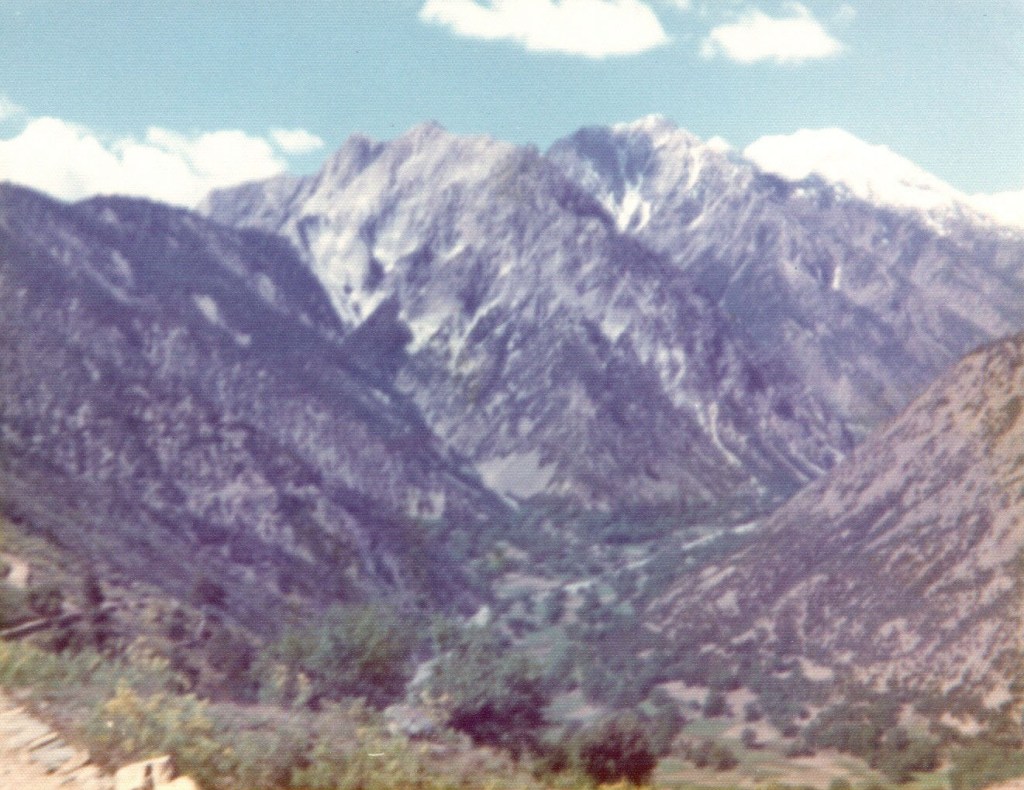
As all the bridges have been washed away, we had to go straight over the mountains which consisted of sheer sliding shale and rock faces – terribly steep. There was a goat path which these three bounded up while we staggered along behind – J suffered most through his stubbornness and refusing to get a porter and his load was far too heavy for such heights. I of course was relieved of my heavy bag, and even then found it exhausting. In places the path that crumbled down the mountain side – often the shale gave away beneath one’s feet, goats above creating minor landslides – did not appease situation, both of mind and physical! Worst parts were two paths of sheer rock and you had to climb straight up with a very nasty drop below.
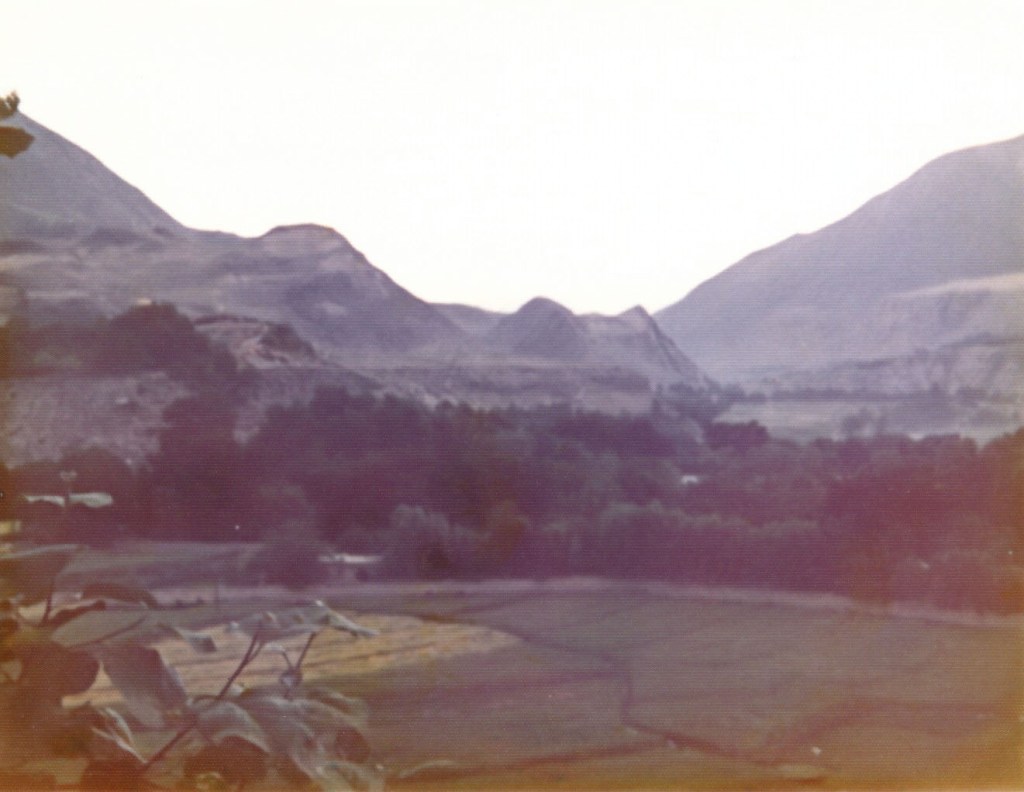
By this time I was being aided by a grey-bearded Chitrali, who unfortunately took every opportunity of getting a good feel of my breasts – but as I was so terrified of falling – especially in the descent, equally if not more treacherous than the ascent as one’s sense of gravity is completely distorted, I didn’t try too hard to stop him!
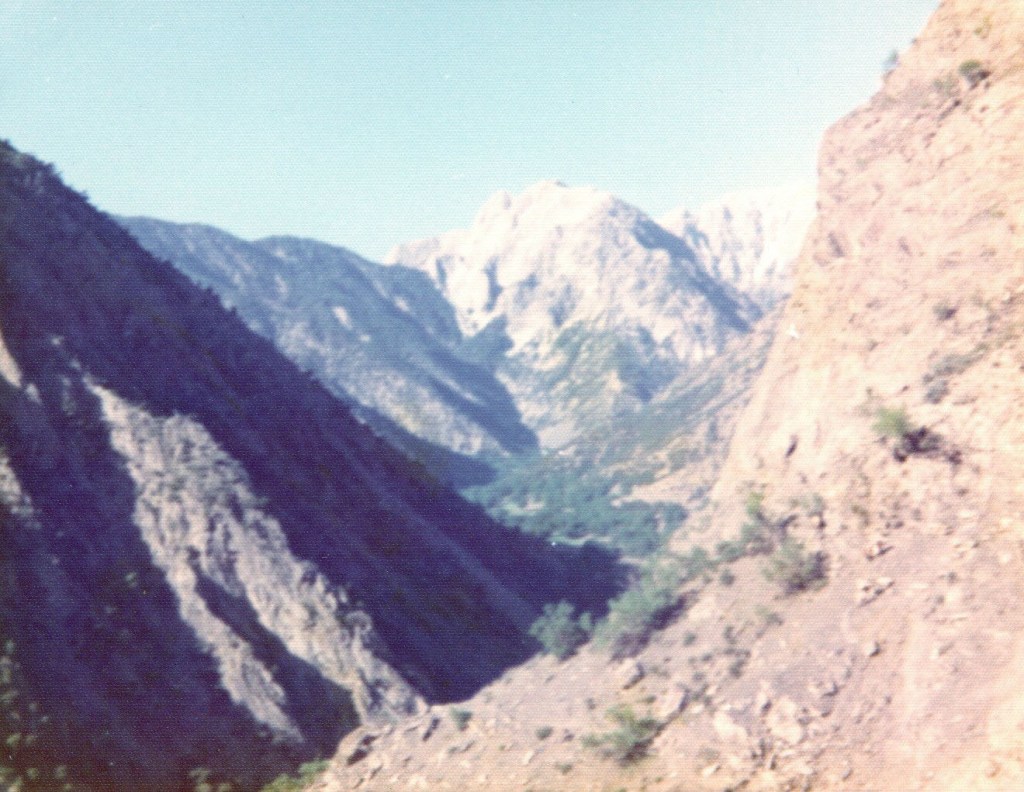
At last we were in Rumbur, totally exhausted. The Chitralis stopped at a friend’s house where we were brought fresh goat’s milk, very pungent-tasting but terribly refreshing. After that they left us with a pack of Marlborough each and we decided to follow the riverbed. Proved extremely difficult as Rumbur is a very narrow gorge, so we were constantly crossing to the other side on makeshift bridges– a plank of wood or stones, water rushing beneath and the sound of crashing rocks as they were carried along. It seemed to take hours, walking in hot sun and never getting anywhere. We both collapsed for half an hour at one point and, when the next person came along, he said it was 3 miles – we didn’t absolutely believe him, but we decided it still sounded far. Off we went again until about half a mile later when we espied a village set high on the cliff, and met two boys who said Balanguru was half a mile away and offered to lead us.
At the foot of the cliff, we could hear drumming, chanting and we were told that the Joshi (Spring festival) – was taking place and that Mr Peter was up there.
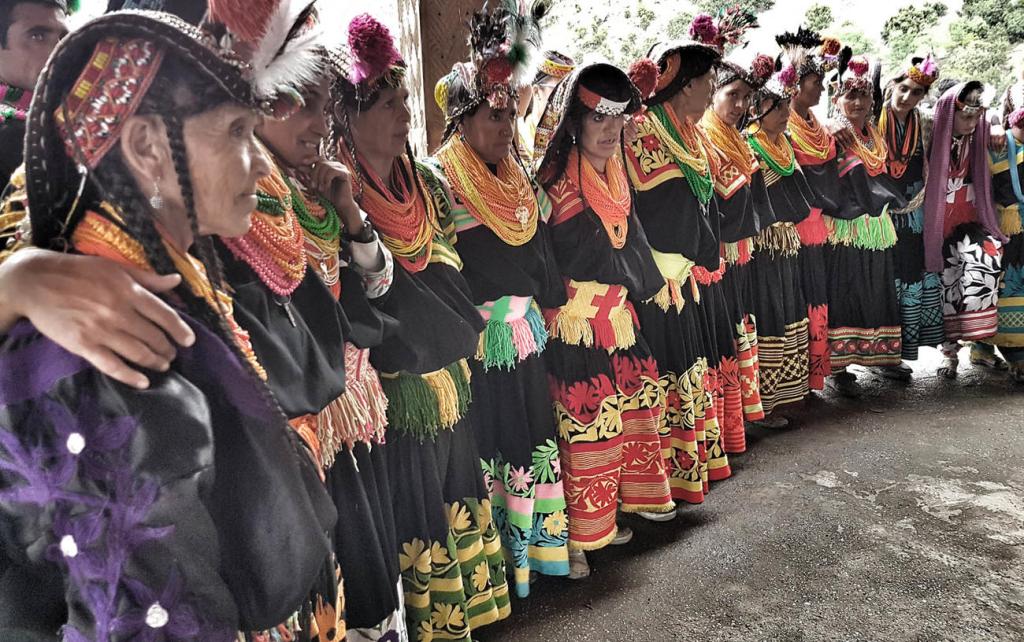
The steep climb up nearly finished me but we were rewarded by seeing Peter splendid in Kalash national dress, amidst all the dancing girls. Seeing our state of exhaustion he led us across the river to Balanguru to his house – accessible by a carved ladder leading on to a balcony, which in turn led into a large room. Buckets of hot water were brought up and placed in a cupboard bathroom, and we had a sort of shower then a long sleep while Peter rejoined the festival.
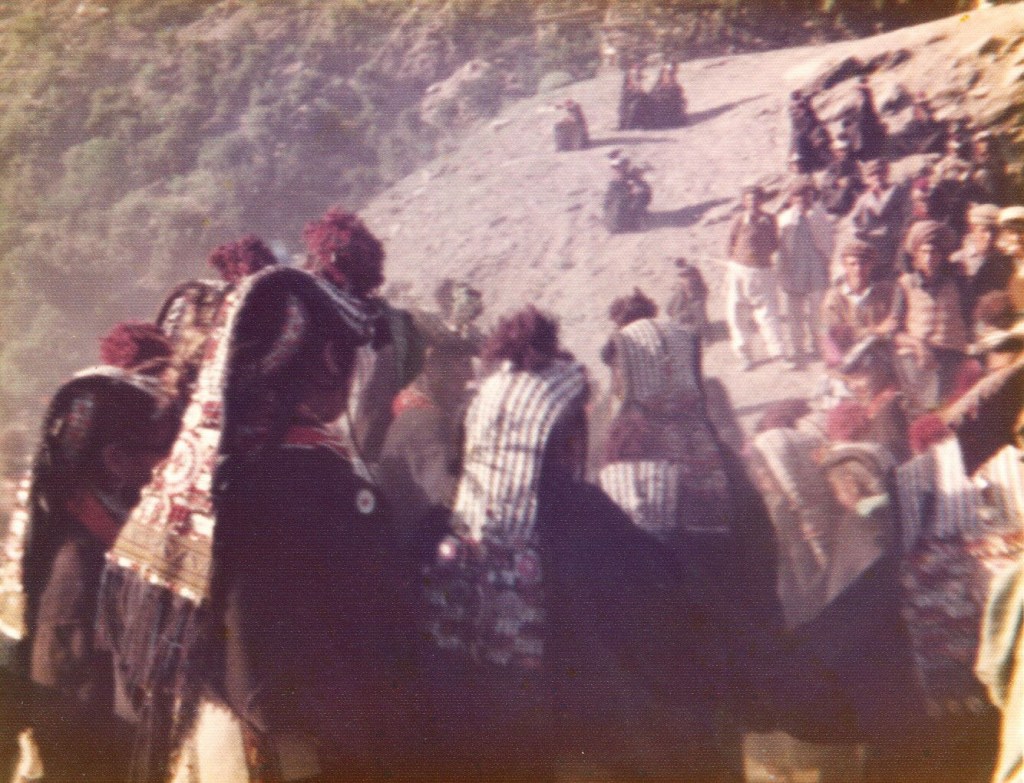
At about 5pm I felt strong enough to brave the ascent to Grom, where the dancing was taking place. A wonderful sight – first a ritual dance with people, men and women in a long line joined to each other by bits of cloth of woven greenery, swaying about like a long snake in a frenzy, accompanied by drumming and chanting. After this they broke up and began to dance in groups of three – first going one way then backwards. I was invited to join two girls and did so. Soon a complete headdress was procured for me looking like this:
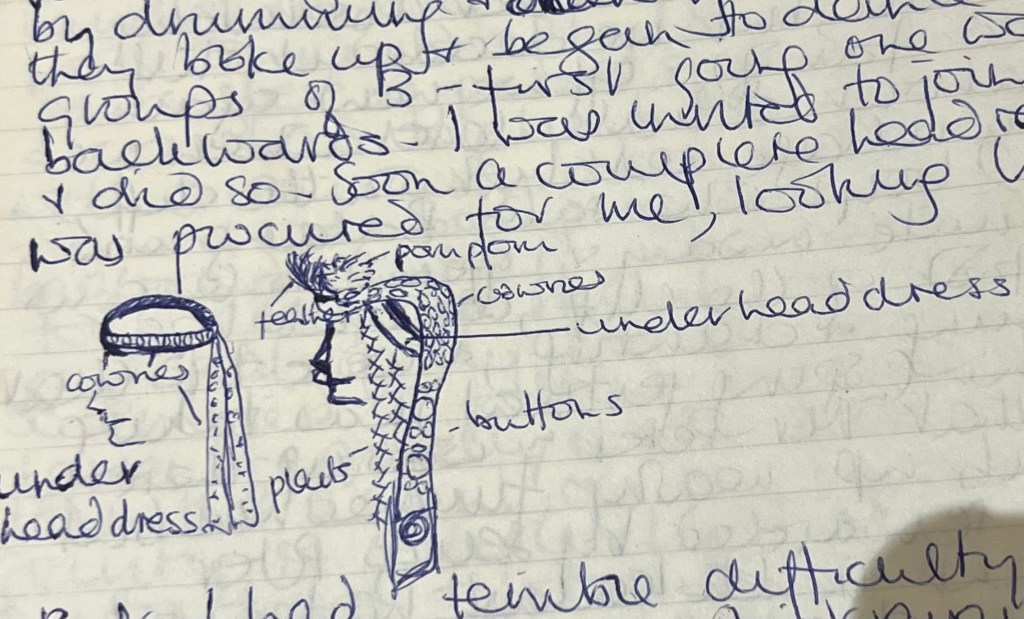
But I had terrible difficulty in keeping it on and had to adjust it every few minutes. Soon a striped blanket was also wrapped around me and I was dancing away just like a Kalash. I dreaded to think what lice and bugs might’ve been in my new attire, and tried not to think about it, and seemed not to suffer afterwards.
We then dance another dance – two lines of women facing each other and then changing sides – as I had nothing to eat all day I left the dance and returned to the house and we had a sort of high tea – rice and lentils and squash, orange and lime.
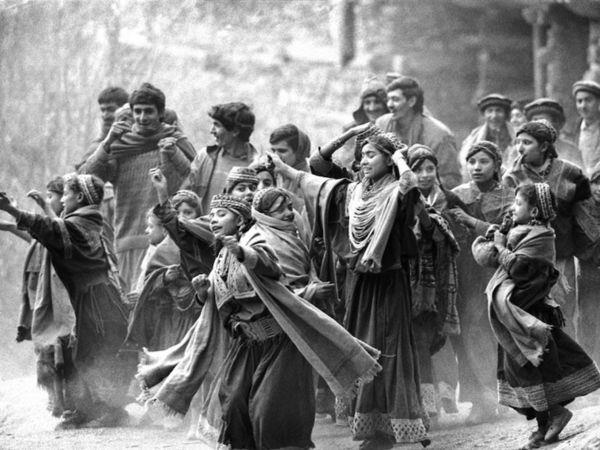
After this we will rejoin the dancing. Peter dances superbly, an old dance in which the spirits can come and possess you and send you into a trance. People were dashing about with sticks, axes, each other – a few scuffles. The Kalash morals are very lax – marriage is for convenience, love exists outside marriage and all the men have married girlfriends, with whom they arrange secret meetings in the cornfields. Occasionally trouble breaks out – with hoo-has about bride wealth etc – men elope with an enemy’s wife etc. All very exciting.
 Vicky's Big Adventure